Dehumidifier Design
Why the Same Air-Change Rate Can Produce Different Indoor Air Quality
Air-change rate describes how much air is moved, but supply and return placement, ductwork and balancing decide whether that air actually reaches every part of a room.
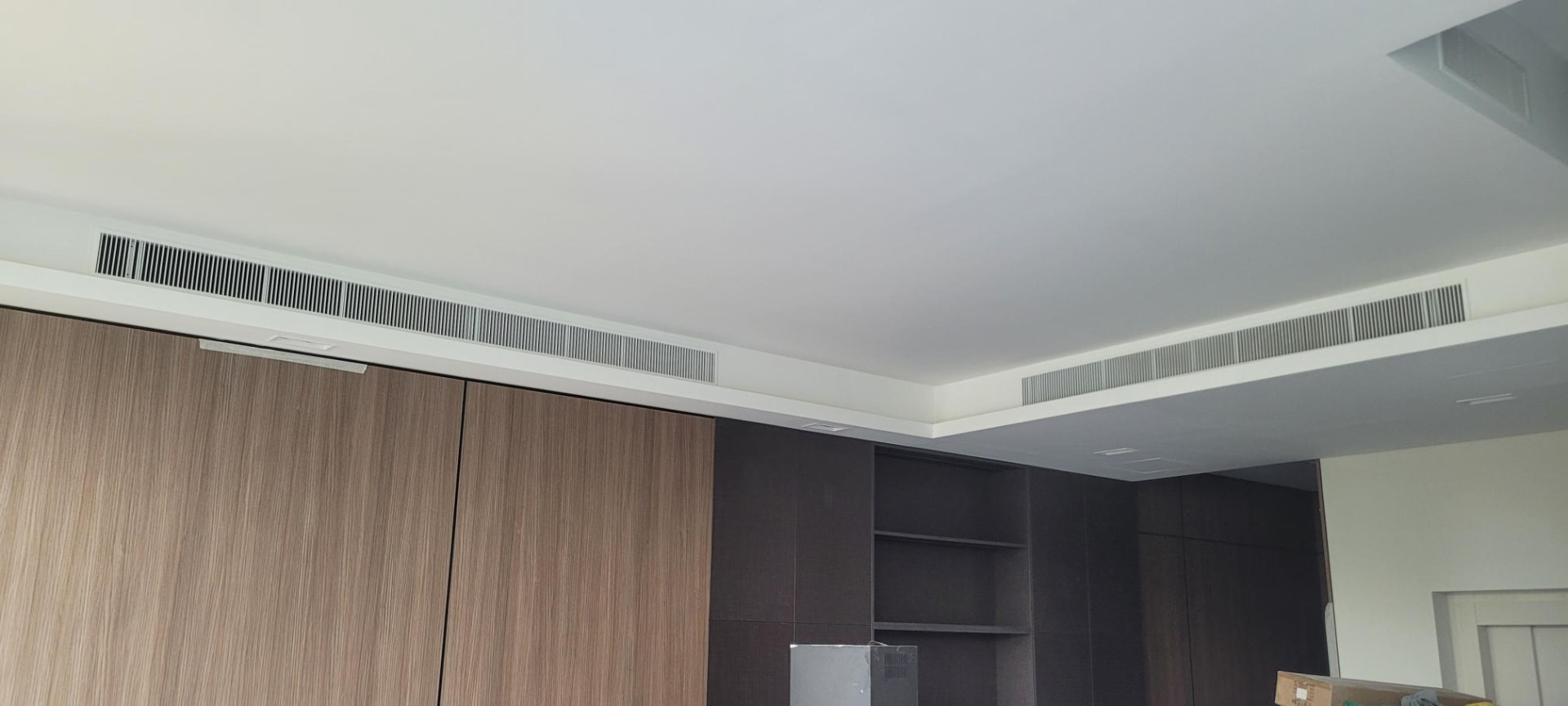
Air changes per hour, or ACH, is commonly used to describe how frequently the air in a room is replaced. A higher ACH can generally help dilute and remove airborne particles, but the number alone does not show how effectively air reaches every part of the room.
Two rooms can have the same air-change rate and still experience different particle concentrations. The reason is simple: indoor air does not always mix evenly.
What recent research found
A recent study published in Building and Environment investigated particle distribution in a living room using experiments and validated computational fluid dynamics simulations.
The researchers examined 118 particle-source locations, three air-change rates—1, 2 and 6 ACH—and three configurations of supply and extract openings.
In one configuration operating at 2 ACH, the average particle concentration at breathing height varied by approximately 215% between the best and worst source locations. In the cases studied, increasing ACH generally reduced particle concentrations more effectively than changing the ventilation configuration. However, particle distribution still depended substantially on where pollutants originated and how air moved through the room.
The conclusion is not that ACH is unimportant. It is that ACH describes air quantity, while actual indoor air quality also depends on air distribution.
Why airflow distribution matters
Air entering a room follows the path created by supply diffusers, return grilles, pressure differences, doors, partitions and furniture.
If supply and return points are too close together, treated air may return to the system before circulating through the occupied area. This is sometimes described as short-circuiting.
Other areas may receive little airflow because they are separated by closed doors or located away from the main circulation path. Increasing equipment capacity does not automatically correct these problems.
For effective air treatment, the system must do more than move a specified volume of air. It must collect air from the intended zones, pass it through the equipment and redistribute it throughout those zones.
What this means for ducted dehumidification and filtration
The same principle applies to humidity control. A concealed dehumidifier may have sufficient nominal capacity for the total floor area, but it cannot control a room effectively if humid air from that room cannot reach the return duct.
ONYX NOVA Core and Zenith dehumidifiers can serve multiple areas through dedicated ductwork, while Aero and PolarStar can support projects that also require fresh-air treatment. In every case, performance depends on correct equipment sizing together with suitable duct dimensions, supply branches, return-air paths and system balancing.
ONYX NOVA dehumidifiers also incorporate primary, HEPA and activated-carbon filtration. However, filter type alone does not define the result. Filtration performance within the property also depends on how much air passes through the filters, how frequently it circulates and whether the airflow reaches all intended zones.
Similarly, an ONYX NOVA Aura filtration system should be designed around the actual AC airflow and the area served by that system. Filtration, ventilation and dehumidification remain different functions, even when they are integrated into the same indoor-air strategy.
What should be checked before selecting equipment?
Before specifying a ducted dehumidifier or filtration system, the following should be reviewed:
- the layout and volume of the rooms;
- which spaces are normally separated by closed doors;
- the location of supply and return grilles;
- available duct sizes and external static pressure;
- the intended airflow through each branch;
- sources of moisture and airborne particles;
- fresh-air supply and uncontrolled infiltration;
- condensate drainage and maintenance access.
For complex villas and commercial properties, drawings and calculations should be supported by an on-site inspection. Post-installation airflow measurement and balancing may also be required to confirm that the intended air volumes are reaching each zone.
Capacity is only part of system performance
Litres per day, airflow and ACH are important design values. But they cannot describe the complete performance of an installed system.
Good indoor-air control requires the equipment and air-distribution system to work together. A correctly selected unit connected to poorly designed ductwork may underperform, while thoughtful supply and return placement can help the system treat occupied areas more consistently.
That is why ONYX NOVA assesses the building layout, moisture conditions, existing AC system and available duct routes before recommending equipment. The objective is not simply to install a dehumidifier or filter. It is to create a workable path for air to be collected, treated and returned to the spaces that need it.
Need help assessing humidity and airflow in your property?
Book an ONYX NOVA inspection in Dubai, Abu Dhabi or elsewhere in the UAE.
Book an InspectionTechnical note: Final equipment selection and expected performance depend on site conditions, system design, outdoor-air conditions and professional assessment.
Related reading
Continue reading.
Dehumidifier Design
Portable vs Ducted Dehumidifiers in the UAE: Why Capacity and Coverage Claims Need Context
Headline capacity and coverage figures are useful for a shortlist, but test conditions, moisture load, airflow and room distribution decide how a dehumidifier performs in a UAE property.
Dehumidifier Design
Why duct sizing matters for a concealed dehumidifier
A concealed unit performs as designed only when the ductwork it is connected to allows the intended airflow.
Indoor Air Quality
Air Purifier, HVAC Filtration or Dehumidifier: What Does Your UAE Property Actually Need?
Portable air purifiers, filtered ducted dehumidifiers and AC-integrated purification treat different indoor-air problems. This guide explains where each approach fits.
Indoor Air Quality
Indoor Air Quality Is More Than Humidity
Normal humidity is only one part of a healthy indoor environment. A recent UAE study highlights why ventilation, filtration and moisture control must be assessed separately.